This is the story of how a morphine-addicted Confederate war veteran's patent medicine, brewed in a three-legged pot in his Atlanta backyard, became the most recognized brand on Earth. It's a story of marketing genius and catastrophic blunders, of secret formulas and perpetual contracts, of world wars and cola wars. It's the story of how a simple drink came to symbolize a nation, conquer the globe, and teach the world to sing. This is the story of Coca-Cola.
The American consumer was born from trauma. In the years after the Civil War, the nation was a landscape of pain. A generation of soldiers returned home with shattered bodies and minds, many of them dependent on the one thing that had reliably eased their suffering on the battlefield: morphine. This epidemic of what was then called "army disease" created a voracious market for remedies, and a new class of entrepreneurs rose to meet the demand. They were the purveyors of "patent medicines," concoctions of leaves, nuts, and alcohol that promised to cure everything from headaches to cancer. Most were not actually patented, but the name lent an air of scientific legitimacy to what was, in reality, a nationwide snake oil boom.
It was this industry that gave birth to the modern American consumer business. These were the first products to be branded and advertised on a national scale, their slogans filling the pages of the country's rapidly growing newspapers. Listerine, Vicks VapoRub, Grape-Nuts—all began their lives in this murky world. And so did Coca-Cola.
Its inventor was Dr. John Pemberton, a Confederate veteran from Atlanta who had been shot and stabbed during the war. Like so many of his comrades, he carried a morphine addiction for the rest of his life. A pharmacist by trade, Pemberton began experimenting with his own remedies, seeking both a commercial success and a cure for his own affliction. His search led him to the coca leaf, the source of cocaine, which was then being hailed as a wonder drug. In 1886, in a three-legged brass pot in his backyard, he brewed a thick, syrupy concoction combining coca leaf extract with the caffeine-rich kola nut. He called it "Pemberton's French Wine Coca."
It was his bookkeeper, Frank Robinson, who saw the true potential. When Atlanta passed prohibition laws, forcing Pemberton to remove the alcohol from his formula, Robinson encouraged him to market it not as a medicinal wine, but as a beverage. It was Robinson who came up with the name "Coca-Cola," believing the two Cs would look well in advertising. And it was Robinson who, in his elegant Spencerian script, penned the flowing logo that remains virtually unchanged to this day.
Pemberton took his syrup down the street to a local drugstore, where it was mixed with carbonated water from a soda fountain. That fizz, that sparkle, was a moment of alchemy. It transformed a thick, medicinal syrup into a refreshing, effervescent drink. People loved it. It offered the dual benefits of a patent medicine—the stimulating kick of cocaine and caffeine—and the simple pleasure of a delicious, sweet beverage.
But Pemberton was a pharmacist, not a businessman. He sold off portions of his company to various partners, and within two years of his invention, he was dead, leaving behind a tangled web of ownership. The man who would untangle it and set Coca-Cola on its path to dominance was Asa Candler, a devoutly religious and fiercely ambitious Atlanta businessman.
Candler was a marketing genius. He understood that Coca-Cola's potential was far greater than that of a simple "brain tonic." As his partner Frank Robinson astutely noted, "We found that we were advertising to the few when we ought to advertise to the masses." Candler began to shift the marketing away from medicinal claims and toward the simple, powerful promise of refreshment. The slogan became "Delicious and Refreshing."
His most brilliant innovation, however, was in distribution. In 1888, the company began mailing out tickets for a free glass of Coca-Cola to every address in the Atlanta city directory. It was the first manufacturer's coupon in American history. This simple idea brilliantly aligned the incentives of the entire value chain. Consumers got a free taste of a delightful new product. Drugstores saw a surge in foot traffic, and they made a handsome profit on every subsequent 5-cent glass they sold. And the traveling salesmen who handed out the coupons had a new, free benefit to offer their customers. It was a virtuous cycle of growth, a masterclass in creating demand.
By the late 1890s, Coca-Cola was a phenomenon, but it was still largely confined to soda fountains. The next great leap would come from two young lawyers from Chattanooga, Tennessee, who came to Candler with a radical proposal: they wanted to bottle Coca-Cola.
Candler was deeply skeptical. Early attempts at bottling had failed; the carbonation went flat, and the taste was inconsistent. But the lawyers, Benjamin Thomas and Joseph Whitehead, were persistent. They offered to take on all the risk. They would buy the syrup from Candler and build the bottling operation themselves. Candler, seeing little to lose, agreed. In 1899, he signed a contract that would become one of the most consequential—and controversial—deals in business history.
For the token price of one dollar (which he never bothered to collect), Candler granted Thomas and Whitehead the exclusive, perpetual right to bottle and sell Coca-Cola across most of the United States. The Coca-Cola Company would sell them syrup at a fixed price of $1 per gallon, forever. There was no clause for inflation, no room for renegotiation. It was a deal that would make the bottlers fantastically wealthy and would haunt the Coca-Cola Company for a century.
Yet, in its own way, it was a stroke of genius. This single contract created a vast, decentralized, and highly motivated army of entrepreneurs. The parent bottlers, Thomas and Whitehead, in turn franchised their rights to hundreds of local business owners. These local bottlers built their own plants, bought their own trucks, and hired their own workers. They were pillars of their communities, and they had every incentive to push Coca-Cola into every corner of the country. The company didn't have to spend a dime on this massive infrastructure. It simply had to make the syrup and cash the checks.
As the 20th century dawned, Coca-Cola faced a new threat: a legion of imitators. Koke, Toka-Cola, Cocanola—over 7,000 copycat brands flooded the market. The company waged a relentless legal war against them, culminating in a 1920 Supreme Court case that established a landmark principle of trademark law. The court declared that the name "Coca-Cola" had transcended its literal meaning. It had become, in the court's words, "a single thing coming from a single source and well known to the community." The brand was the real thing, and the law would protect it.
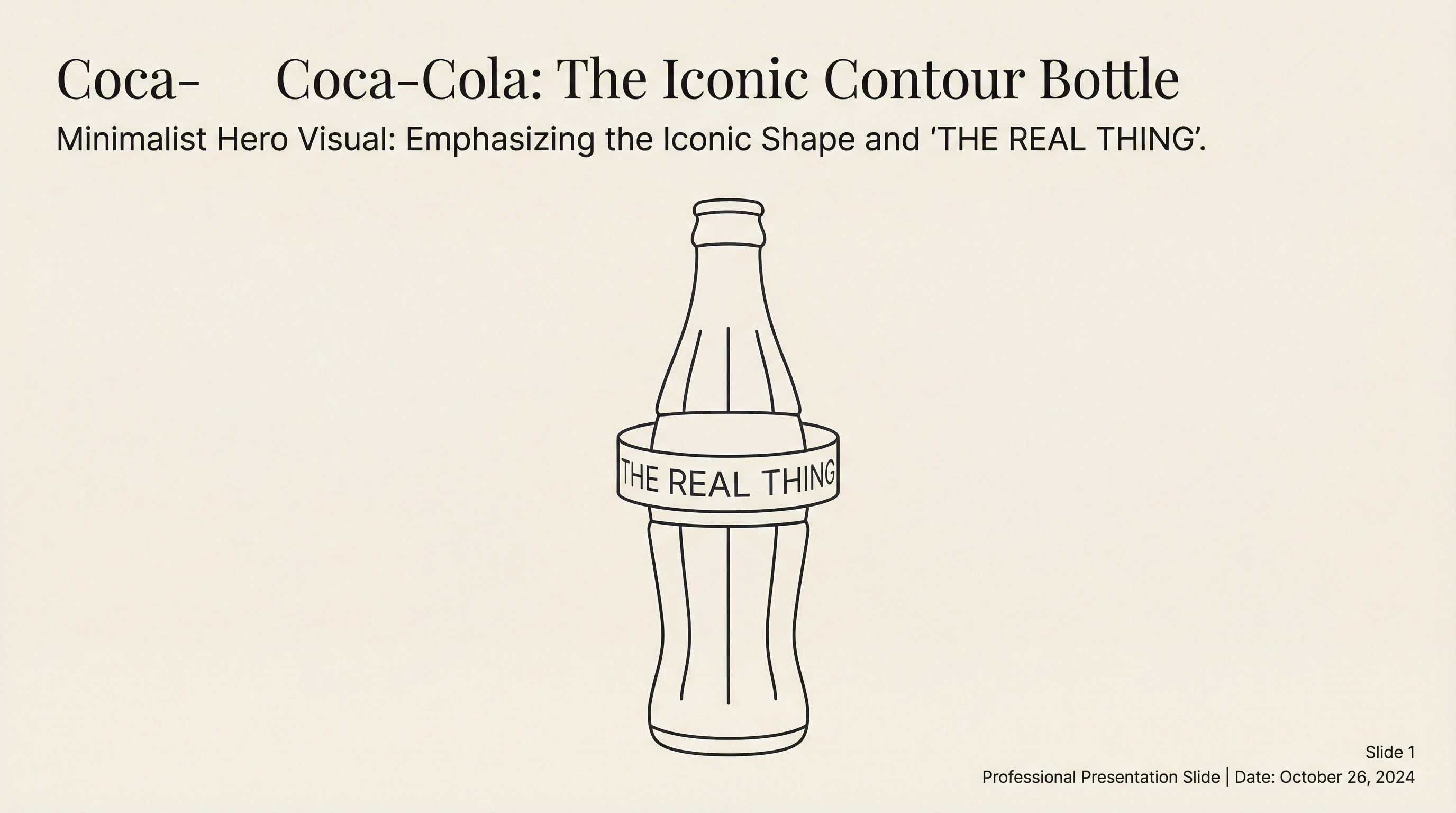
To further distinguish itself, the company commissioned a proprietary bottle. In 1916, the iconic contour bottle was born, its shape so distinctive it could be recognized by touch in the dark, or even when shattered on the ground. It was another powerful weapon in the war against imitators.
In 1919, Asa Candler sold the Coca-Cola Company to a syndicate of investors led by an Atlanta banker named Ernest Woodruff for $25 million. It was the largest business transaction in the history of the American South. But it was Ernest's son, Robert Woodruff, who would truly shape the company's destiny.
Robert Woodruff was everything his stern, conservative father was not. He was a charismatic, hard-living man of the world, a friend of baseball star Ty Cobb, and a rising executive at the White Motor Company. He was being courted by Standard Oil to be its next CEO. When his father's investment in Coca-Cola faltered, the board, against Ernest's wishes, insisted on considering Robert for the presidency. In 1923, at the age of 33, Robert Woodruff took the helm, on the condition that his father exit the business entirely. He would run Coca-Cola for the next 60 years, first as president and then as the undisputed patriarch from behind the scenes. He was, and would forever be known as, "The Boss."
Woodruff's vision was simple and absolute: Coca-Cola should be available to everyone, everywhere. He partnered with an adman named Archie Lee, and together they pioneered what we now call lifestyle advertising. They stopped talking about the product and started selling the feeling. Their ads depicted a world of idyllic moments—a pause that refreshes, a social gathering, a moment of joy—all made better with a Coke. Their most enduring creation came in 1931, when they commissioned an artist named Haddon Sundblom to create a new image for Santa Claus. Before Sundblom, Santa was depicted as a tall, gaunt figure, sometimes even spooky. Sundblom's Santa—warm, jolly, and dressed in Coca-Cola red—became the definitive image of the character for the entire world.
Woodruff was also a master of operations. He saw the rise of the automobile and decreed that Coca-Cola must be in every gas station. The company designed and distributed tens of thousands of bright red coolers, making an ice-cold Coke an integral part of the American road trip. He introduced the six-pack carton, making it easier for people to bring Coke home. And he began expanding internationally, setting up bottlers in Europe and South America.
Then came World War II, and Coca-Cola became an instrument of American power. Woodruff made a solemn pledge: every American soldier would be able to get a bottle of Coca-Cola for 5 cents, wherever they were in the world. The U.S. government, recognizing the drink's morale-boosting power, granted Coca-Cola employees "technical observer" status, allowing them to travel with the military. As American forces advanced across Europe and the Pacific, a Coca-Cola bottling plant was often not far behind. The company built 64 new bottling plants overseas during the war, laying the foundation for its global dominance. When the war ended, Coke was no longer just an American drink; it was a symbol of the American way of life, a taste of freedom and prosperity that had been introduced to a war-torn world.
But as Coke entered the 1950s, a shadow began to grow. Its rival, Pepsi-Cola, had long been a distant second, but under the leadership of a former Coke executive named Alfred Steele, it began to mount a serious challenge. Steele repositioned Pepsi as the drink for the young and modern, a stark contrast to Coke's more traditional image. He targeted black consumers, a market Coke had largely ignored. And he embraced television, a medium Coke was slow to adopt.
In 1955, Coke's new ad agency, McCann Erickson, conducted a secret blind taste test. The results were shocking: a statistically significant number of people preferred the sweeter taste of Pepsi. When the findings were presented to Woodruff, his response was swift and absolute: "Do not ever share this with anyone and do not ever run this test again."
For twenty years, that secret was kept. But in 1975, Pepsi unleashed a marketing campaign that would change the industry forever: the Pepsi Challenge. In malls and supermarkets across the country, real people were asked to take a blind taste test. Time and again, they chose Pepsi. The campaign was a masterstroke of grassroots marketing, a direct assault on Coke's claim to be the "real thing." It was devastatingly effective because it was true.
Coke, the monolithic, top-down corporation, was ill-equipped to respond. Its market share began to erode, year after year. The company finally responded in 1982 with the launch of Diet Coke. It was a runaway success, becoming the number three soft drink in America within a year. But it didn't solve the fundamental problem: in the core, full-calorie cola segment, Pepsi was winning.
By 1985, the company was in crisis. Under the leadership of CEO Roberto Goizueta, a brilliant but embattled strategist, Coca-Cola made a decision that would become the most infamous blunder in the history of marketing. After 99 years, they were going to change the sacred formula.
The new formula, sweeter and smoother, had been exhaustively tested. In blind taste tests, it beat both Pepsi and the original Coke. The company was confident. But they had made a fatal miscalculation. They had tested the taste, but they had forgotten to test the feeling.
On April 23, 1985, they announced the launch of "New Coke." The backlash was immediate and ferocious. The public didn't just dislike the new taste; they felt betrayed. The company had taken away their Coke. Thousands of angry calls flooded the company's headquarters. Protest groups formed. People began hoarding cases of the original formula. It was a national crisis.
Pepsi, naturally, gloated. They ran full-page ads declaring, "After 87 years of going at it eyeball to eyeball, the other guy just blinked."
Seventy-nine days after it had launched New Coke, the company capitulated. In a press conference that was broadcast live on national television, a humbled management team announced that the original formula would be returning, rebranded as "Coca-Cola Classic." The nation rejoiced. In a strange and unexpected way, the disaster had been a triumph. The company had been reminded, in the most painful way possible, that its brand was more than just a product. It was a cultural icon, an object of deep emotional connection for millions of people.
The New Coke fiasco marked the end of an era. The company, chastened and newly aware of its own vulnerability, began to evolve. It embraced a portfolio strategy, acquiring and building a vast array of beverage brands—Sprite, Fanta, Minute Maid, Powerade, Vitaminwater—transforming itself from a single-product company into a total beverage powerhouse. It handed its advertising to the powerful Hollywood talent agency CAA, led by Michael Ovitz, who created a new, more modern aesthetic, including the beloved Christmas polar bear ads.
Today, the Coca-Cola Company is a global empire, serving 2.2 billion drinks every day. It is a testament to the power of a brand, a brand built on a secret formula that may or may not matter, a perpetual contract that was both a blessing and a curse, and a century of brilliant, and sometimes disastrous, marketing. It is the story of a simple drink that, through a combination of ambition, innovation, and sheer historical accident, became the real thing.
Ben HadleyBASIC
Ben Hadley may produce accurate information about automotive SaaS.